| Location | Chicago, Illinois, USA |
| Price range | ~$220/€202/£173 — ~$700/€642/£549 per night |
| Best for | Architecture lovers, business travelers, couples, anyone who appreciates a genuinely great bar |
| Sweet spot | May–June or September–October. Winters are genuinely brutal |
| Skip if | You want a boutique hotel with exposed brick and a curated vinyl collection |
| Book | Browse Chicago historic hotels on Booking.com |
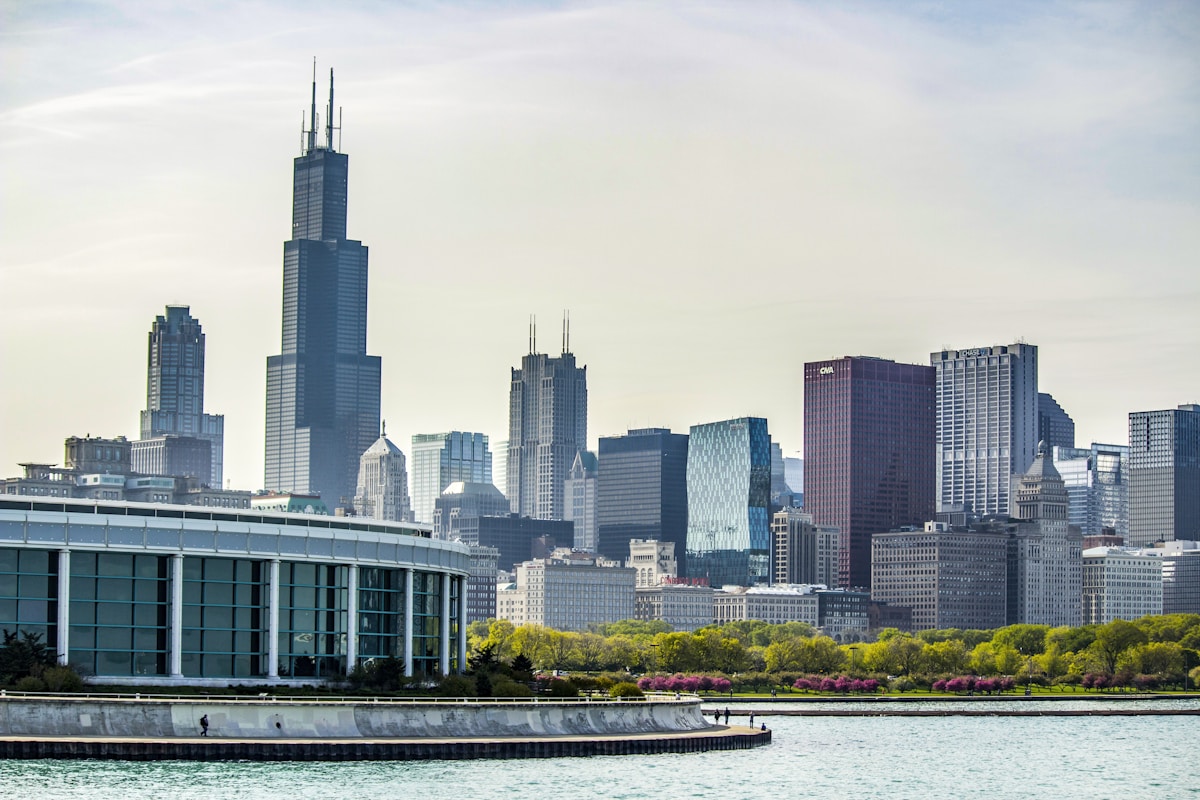
Chicago doesn’t do anything at a human scale. The buildings are too tall, the lake is too vast, the wind is too persistent, the deep dish pizza is genuinely too much food. I’ve been coming here for years and I still find myself craning my neck on the same corners I’ve stood on a dozen times, looking up at the same buildings with the same sense that the city is doing something architecturally that it hasn’t entirely finished explaining.
The historic hotels here are products of that same sensibility. They were built to impress, to dominate, to say something unambiguous about Chicago’s position in the hierarchy of American cities at the moment of construction. They’re not subtle. They’re not supposed to be.
What makes them worth visiting in 2026 is that most of them have survived intact through a century of change — the Depression, urban renewal, the slow abandonment of downtown hotels in the 1970s and 80s, and then the revival. The ones that made it through all of that have bones that money genuinely can’t buy anymore.
Here’s my honest take on Chicago historic hotels before we get specific: the Magnificent Mile corridor gets all the attention but the Loop and South Loop properties are more interesting and frequently cheaper. If you’re here for the architecture, stay near the architecture.
Browse Chicago historic hotels on Booking.com
What Makes Historic Chicago Hotels Different
Chicago invented the modern skyscraper. This is not hyperbole — the 1885 Home Insurance Building (demolished in 1931) is generally credited as the world’s first skyscraper, and the city spent the next four decades in a sustained architectural competition with itself that produced some of the finest commercial buildings ever constructed.
The hotels are part of that story. The Palmer House was the first hotel in America to be electrified and the first to have a telephone in every room. The Drake was built to outshine every East Coast hotel that Chicago businessmen had to stay in when they traveled. The Congress Plaza hosted every US president from McKinley to Clinton. These weren’t just places to sleep — they were statements of civic ambition. They reflect historic Chicago through architectural grandeur, famous guests, and the city’s different cultural origins.
That ambition is still in the buildings. Walk through the Palmer House lobby and you understand it immediately: this was meant to tell you something about what Chicago thought of itself in 1873.
For the full picture of the city these hotels belong to, see our Chicago city guide.
The Hotels
1. Palmer House Hilton (Est. 1873)
The Palmer House has a creation myth that’s almost too good: Potter Palmer built the original hotel in 1871 as a wedding gift for his wife Bertha, and it opened 13 days before the Great Chicago Fire burned it to the ground. The original building fell victim to the fire, but the rebuilt property became known for early innovations including the light bulb, telephone, and vertical steam lift. Palmer rebuilt it immediately — bigger, better, the most luxurious hotel in America.
The version standing today is the third Palmer House, completed in 1925, and the lobby is legitimately one of the most extraordinary interior spaces in American hospitality. Twenty-one ceiling paintings by French artist Louis Pierre Rigal, modeled on the mythological paintings at Versailles. Marble floors. Grand historic places within the hotel still shape the experience, with spaces like the Crystal Ballroom showing how original ballrooms and lobbies can give you a real glimpse into the past. A scale that suggests the decorator was using a different unit of measurement than normal humans.
I’ve brought three different people to the Palmer House lobby without telling them where we were going, and all three had an immediate physical reaction — a kind of involuntary stillness. One of them said, “Why does this exist in a hotel?” Which is exactly the right question.
The rooms are not the lobby. The rooms are complete for modern guests, with comforts like complimentary WiFi and high-definition TVs, while still feeling like a good, well-maintained, full-service Hilton Hotel. The lobby is a museum piece you happen to be sleeping adjacent to.
Its long cultural history also includes figures like Oscar Wilde and, later, Truman Capote, which helps explain why the property remains on the National Register.
| Room Type | Size | Price/night | Best for |
|---|---|---|---|
| Standard room | 30m² | ~$220/€202/£173 | Best value on this list |
| Deluxe room | 38m² | ~$300/€275/£235 | More comfortable base |
| Corner suite | 65m² | ~$550/€504/£432 | The Chicago experience |
We’ve since written the full standalone review — see Palmer House Hilton for the complete rundown on rooms, the brownie origin story, and honest pricing.
Check availability at Palmer House Hilton →
2. The Drake Hotel (Est. 1920)
The Drake opened on New Year’s Eve in 1920 and quickly became the premier choice for international royalty, celebrities, and politicians. The guest list from the opening week reads like a Forbes list of 1920 — Rockefellers, Vanderbilts, the usual suspects. Queen Elizabeth II stayed here. Princess Diana stayed here. It has also welcomed presidents and cultural figures such as Amelia Earhart, Walt Disney, Dean Martin, and Rudolph Valentino. There’s even a bit of Chicago lore about hidden passageways uncovered by President Obama’s Secret Service detail.
The location at the northern end of Michigan Ave, facing Lake Michigan, was deliberate — the architects wanted the hotel to be the period at the end of the Magnificent Mile sentence. A hundred years later, it still works. The view north from the upper floors over Oak Street Beach and the lake is genuinely one of the best views in Chicago.
The Cape Cod Room in the basement is the detail I always tell people about: a seafood restaurant that’s been operating continuously since 1933, with the same red-checked tablecloths, the same dark wood paneling, the same lobster bisque that Frank Sinatra allegedly had flown to him in Las Vegas on multiple occasions. The bisque is ~$18/€16/£14 and it’s the kind of thing you order once and then structure future Chicago trips around. The hotel’s dining traditions also include its daily afternoon tea, a Chicago staple for generations.
| Room Type | Size | Price/night | Best for |
|---|---|---|---|
| Lake view room | 32m² | ~$380/€348/£298 | The reason to stay here |
| City view room | 32m² | ~$300/€275/£235 | Same hotel, lower price |
| Junior suite | 55m² | ~$550/€504/£432 | Special occasion |
We’ve since written the full standalone review — see The Drake Hotel for the Cape Cod Room bisque, room-by-room breakdown, and honest pricing.
Check availability at The Drake →
3. The Blackstone (Est. 1910)
The Blackstone opened on April 6, 1910, and has hosted 12 U.S. presidents; it’s also the place where the back-room deal that gave Warren G. Harding the 1920 Republican presidential nomination happened in Suite 408-409. The phrase “smoke-filled room” — still used in political journalism — was coined by a reporter describing that meeting. The suite is still there. You can book it.
Whether Harding deserved the nomination or the presidency is a different question. (He did not, but that’s for another article.) The point is that “smoke-filled room” as a concept for how American politics actually works was born in this building, in this specific suite, and that’s genuinely extraordinary. The hotel’s name comes from Timothy Blackstone, who served as president of the Chicago & Alton Railroad.
Jimmy Carter is one of the presidents tied to the property’s political history. Al Capone, whose influence had deep roots in Chicago, was also associated with the former barbershop.
The Blackstone was restored in 2008 after a period of decline, and the restoration is one of the best examples of historic hotel renovation I’ve seen. The architects found original drawings, located surviving decorative elements in storage, and rebuilt the interiors with the specificity they deserved. The ballroom ceiling alone represents years of restoration work.
| Room Type | Size | Price/night | Best for |
|---|---|---|---|
| Classic room | 28m² | ~$250/€229/£196 | Solid Loop location |
| Superior room | 36m² | ~$320/€293/£251 | Better proportions |
| Suite 408-409 | 80m² | ~$700/€642/£549 | Political history nerds |
Check availability at The Blackstone →
4. The Congress Plaza Hotel (Est. 1893)
The Congress Plaza was built for the 1893 World’s Columbian Exposition — the same event that gave the world the Ferris wheel, Juicy Fruit gum, and Cracker Jack, and that was the subject of Erik Larson’s The Devil in the White City. It opened as the Auditorium Annex and has been operating on Michigan Avenue facing Grant Park for over 130 years.
Hot take: the Congress Plaza is the most interesting hotel on this list and also the most complicated recommendation. Parts of it are impeccably maintained. Other parts are in various states of renovation that have been ongoing for years. It has genuine architectural grandeur — the Florentine Room, the Gold Room, the original staircase — and it also has rooms that are simply old hotel rooms with old hotel room problems.
I stayed in the Gold Room corridor and the experience was excellent. The key is knowing specifically what you’re booking. Do your research on the specific room category.
The price is the thing: you can stay here for ~$180/€165/£141 on weeknights in the shoulder season. For a building with this much history, on this block, in this city, that’s genuinely remarkable value.
| Room Type | Size | Price/night | Best for |
|---|---|---|---|
| Standard room | 28m² | ~$180/€165/£141 | Best value option |
| Historic wing room | 35m² | ~$250/€229/£196 | Get the good part |
| Gold Room suite | 70m² | ~$450/€413/£353 | Full historic experience |
We’ve since written the full standalone review — see Congress Plaza Hotel for the corrected Room 441 ghost lore, the real Capone story, and the decade-long labor strike history.
Check availability at Congress Plaza Hotel →
Food & Drinks — Chicago Edition
Chicago has one of the best food cities in America, and the historic hotels have figured out that they need to earn their place in that ecosystem.
- Breakfast: The Palmer House’s Lockwood Restaurant does a full American breakfast for ~$28/€26/£22 per person. Good, not transcendent. For transcendent, walk three blocks to Lou Mitchell’s (Est. 1923), a diner that opens at 5:30am and has been feeding Chicago since before the Depression
- The Drake’s Cape Cod Room:
$35–55/€32–50/£27–43 for mains. Order the lobster bisque ($18/€16/£14). Order the Dover sole if you’re feeling flush (~$52/€48/£41). Do not order the early 1980s-era cocktail menu - Bar of the trip: The Coq d’Or at The Drake, established 1933. Dark wood, low lighting, a piano player on weekends, and a bartender who in my experience has been willing to make anything you describe even if it’s not on the menu
- Skip: Hotel room service in Chicago is almost universally overpriced relative to what’s available within a two-block walk of any of these properties. Go outside
- Signature Chicago drink: An Old Fashioned made with Malört, which is a local bitter liqueur that Chicagoans insist visitors try and visitors insist they will never try again. ~$12/€11/£9 and genuinely an experience
Things Most Chicago Hotel Guides Get Wrong
-
The Loop is not dead at night. The narrative that downtown Chicago empties after 5pm is outdated. The restaurant and bar scene in and around the Loop has genuinely improved. You do not need to be in River North or Lincoln Park to have a good evening.
-
Request a high floor specifically. Chicago’s historic hotels are tall but the lower floors can have compromised views or street noise. Always call and ask about high floor availability in the historic wing when booking The Drake or Palmer House.
-
The Metra is underused by visitors. Chicago has a suburban rail network (Metra) that connects to Millennium Station, one block from the Palmer House and Blackstone, with Millennium Park also within walking distance from the central historic hotels. If you’re coming from O’Hare, the Blue Line is faster and cheaper (~$5/€4.60/£3.93) than a cab.
-
Winter pricing is genuinely low. January and February in Chicago are cold in the way that makes you question your decisions. The hotels know this and price accordingly. You can stay at The Drake in February for prices that seem implausible. If you’re a person who dresses warmly and finds a frozen Lake Michigan beautiful (it is), this is the move.
-
The architectural boat tours from the Chicago River are the best thing in the city. Not hotel-specific, but every hotel concierge should tell you this and not all of them do. Book through the Chicago Architecture Center. ~$55/€50/£43 for 90 minutes and you will understand Chicago in a way that no amount of walking can teach you.
The Catch
-
The Palmer House lobby and the Palmer House rooms are two different quality levels. The lobby is extraordinary. The rooms are a large, well-run Hilton. If you’re staying for the rooms, there are better-maintained boutique options nearby. If you’re staying for the lobby, the history, and the price, the Palmer House is hard to beat — the trade-off is spectacular historic public space versus more standard guest-room finishes.
-
Chicago hotel taxes are brutal. The city has one of the highest hotel tax rates in America — roughly 17.4% on top of the room rate. This is not a rounding error. Factor it into your budget.
-
The Congress Plaza is a gamble. Extraordinary history, variable room quality. Read specific room reviews before booking and do not assume the historic grandeur of the public spaces extends uniformly to the guest rooms.
-
Weather windows are narrow. May–June and September–October. Everything else is either too hot, too cold, or too humid. I don’t make the rules.
Is It Worth It?
| Worth it? | |
|---|---|
| Architecture lovers | ✓ Absolutely — you’re sleeping inside Chicago’s architectural history |
| Business travelers | ✓ Palmer House and Drake are ideal — location, service, infrastructure |
| Couples | ✓ The Drake for romance; The Blackstone for interesting conversation |
| Budget travelers | ✓ Congress Plaza and Palmer House standard rooms are genuine value |
| Summer visitors | ⚠️ Hot and humid July–August; manage expectations |
| January visitors | ✓ Cheap rates, dramatic lake views, actual quiet |
Chicago’s historic hotels are some of the best-value grand hotel experiences in America. The Palmer House lobby alone is worth a visit even if you’re not staying — but staying gives you the full effect. The Drake is the most consistently excellent hotel experience on this list. The Blackstone is the most interesting piece of political history you can sleep in.
Practical Info
- Getting there: O’Hare (ORD) → Blue Line CTA to the Loop, ~45 min, ~$5/€4.60/£3.93. Midway (MDW) → Orange Line, ~30 min, ~$5/€4.60/£3.93. Cab from O’Hare ~$45–55/€41–50/£35–43
- Getting around: CTA Red and Blue Lines cover the main corridors. Walk the Magnificent Mile. Uber/Lyft for evenings
- Parking: ~$45–65/€41–60/£35–51 per day at downtown garages. Don’t drive in Chicago if you don’t have to
- Check-in/out: 3pm / 11am standard across all properties
- Best room tip: Always ask for a high floor, city or lake view, in the historic wing
- Languages: All properties have multilingual staff
Final Verdict
Chicago’s historic hotels are underrated relative to their New York counterparts and significantly better value. The Palmer House is the essential Chicago hotel experience — Versailles-level lobby, Loop location, honest prices. The Drake is the most romantic. The Blackstone is the most interesting.
Come in October. Walk the lakefront. Take the architecture boat tour. Have the Cape Cod Room bisque. Look up constantly.
Browse Chicago historic hotels on Booking.com
Prices start at ~$180/€165/£141 per night at Congress Plaza. Add 17.4% city tax to all rates when budgeting.
Affiliate Disclosure: Some links in this article are affiliate links. We may earn a small commission if you book through them, at no extra cost to you.

Written by
Eleanor Rhodes
Founding Editor
Eleanor has spent 20 years documenting America's endangered historic properties. A certified historic preservation specialist, she believes the best way to save old hotels is to fill their rooms.