Chicago, Illinois
Palmer House Hilton
Est. 1927 · Beaux-Arts · $$$
The third Palmer House on this site since 1871, with a lobby ceiling that has no business existing above a Hilton front desk. Birthplace of the brownie. Survived a fire that leveled the first one. Honest 2026 review.
I have stood in a lot of hotel lobbies and made a lot of internal jokes about the marble. I did not make a joke in the Palmer House lobby. I walked in off Monroe Street, looked up, and stopped walking entirely — hard enough that someone with a rolling suitcase clipped my heel and apologized to me, which felt backwards.
Twenty-one ceiling panels, painted by a Frenchman, loosely riffing on Versailles, sitting above a hotel where you can also just… check in for a Tuesday night stay and get a Hilton Honors point balance update on your phone. That contrast is the entire Palmer House experience in one sentence, and I mean that as a genuine compliment before I get into the parts that annoyed me.
| 📍 Location | 17 East Monroe Street, Chicago Loop, Illinois |
| 💰 Price range | ~$220/€202/£173 per night |
| ⭐ Best for | Architecture lovers, history nerds, business travelers who want a story with their expense report |
| ⏱️ Sweet spot | May–June or September–October |
| 🚫 Skip if | You want your room to match the lobby’s grandeur |
| 📖 Book | Palmer House Hilton on Booking.com |
Check availability and current rates →
If you haven’t yet picked your neighborhood, our Chicago city guide is a reasonable place to start before you commit to the Loop.
The History Nobody Tells You
Here’s the version most front-desk staff will give you if you ask: Potter Palmer built the original Palmer House in 1871 as a wedding gift for his wife, Bertha Honoré Palmer. It opened on September 26. Thirteen days later, the Great Chicago Fire burned it to the ground. Thirteen days. I’ve had hotel stays go worse than that but not by much, and none of them ended with the entire building becoming a load-bearing metaphor for civic disaster.
What most people don’t get told is what Palmer did next, which is the actually interesting part. He didn’t rebuild modestly and he didn’t rebuild slowly — he borrowed heavily against a reputation that, at that exact moment, had every reason to be shot, and put up a second Palmer House in 1873 that he marketed, without much subtlety, as “the world’s first fireproof building.” It’s also credited as the first hotel anywhere with electric lighting throughout and a telephone in every room. Chicago had just burned down and Potter Palmer’s response was to build the most technologically forward hotel on the planet on the same lot. That is either supreme confidence or a very specific kind of denial, and either way it worked.
The building you’re actually walking into today is the third Palmer House, completed in 1927 by the Chicago firm Holabird & Roche — so when people say “Palmer House,” they’re compressing three different buildings and 150-odd years into one name, and it’s worth knowing which one you’re standing in. This is the one with the lobby ceiling: 21 panel paintings by French artist Louis Pierre Rigal, done in a mood that’s aiming pretty directly at Versailles and mostly gets there. I’ve read plenty of hotel marketing copy that calls a chandelier “breathtaking.” This is one of the rare instances where a hotel lobby genuinely earns that word, and I say that as someone paid to be skeptical of it.
The Bertha Palmer side of the story deserves more attention than it gets. She wasn’t a passive wedding-gift recipient — she was a serious art patron who assembled one of the first significant Impressionist collections in the United States, Monet and Renoir and Degas, well before most American museums had caught on, and much of it eventually went to the Art Institute of Chicago, a few blocks from where you’re standing. She’s also, more famously among people who eat, the reason the brownie exists. She asked the hotel’s pastry chefs to make a dessert for boxed lunches served to lady visitors at the 1893 World’s Columbian Exposition — something smaller than cake, portable, that wouldn’t require a fork. The Palmer House still serves what it calls the original recipe. I ordered it out of journalistic obligation and then ordered a second one out of no obligation at all.
Guests over the decades have included Oscar Wilde and, later, Truman Capote — the kind of guest list a hotel this size accumulates just by staying open and interesting for a century and a half.
Book the room under the ceiling →
The Rooms — Real Talk
This is the section where the Palmer House gets a little less mythical, so let’s do it properly.
| Room Type | Price/night | Best for |
|---|---|---|
| Guest Room, City View | ~$220/€202/£173 | Best value, no ceiling views but a great location |
| Deluxe King | ~$300/€275/£235 | More space, more reliably updated finishes |
| Tower Suite | ~$550/€504/£432 | Guests who want the Palmer House name to extend past the lobby |
The rooms are a genuinely well-run Hilton: comfortable beds, reliable air conditioning, fast WiFi, the kind of predictable competence you’d want from a 1,600-room property that’s part of a global chain. What they are not is an extension of the lobby’s fantasy. There is no gold leaf on the nightstands. The bathrooms are recently renovated and perfectly nice and look almost exactly like the bathrooms in any upper-midscale Hilton anywhere in the country. If you check in expecting the ceiling paintings to continue up the elevator, you will be a little deflated by 4pm.
I don’t think this is a flaw exactly — it’s a trade-off, and one the hotel makes on purpose. You’re paying Loop-hotel prices for a public space that would cost a fortune to reproduce today, and paying standard rates for rooms that are simply good rooms. Ask for a higher floor and a renovated room category specifically; the property has been updated in phases and the difference between an older room and a recently refreshed one is more noticeable than the price difference.
Food & Drink
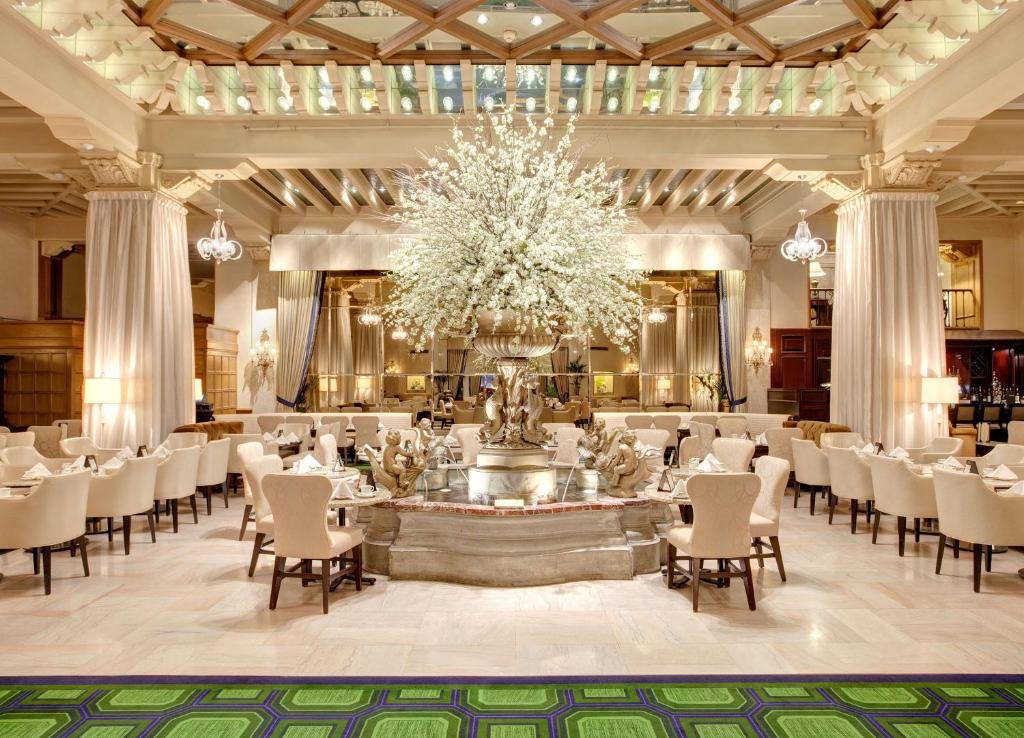
The hotel’s dining room, Lockwood, does a competent American breakfast and a solid business lunch, but the real food story here predates the restaurant by over a century.
- The brownie: Order it at the hotel, non-negotiably. This is where it was invented, in 1893, at Bertha Palmer’s request, and the “original recipe” claim is one of the few pieces of hotel lore I’d actually stand behind. ~$8/€7/£6 a slice.
- Breakfast elsewhere: Lou Mitchell’s, a few blocks west, has been serving Chicago since 1923 and will outclass most hotel breakfast rooms in the city, this one included.
- Coffee: There’s a Trader Vic’s-adjacent lounge history in this building I won’t overstate, but the current lobby-level coffee counter is fine for a fast morning fix before you go look at the ceiling again.
- Dinner: Walk it. The Loop and South Loop have improved substantially in the last decade and you’re a five-minute walk from better options than most hotel restaurants in this price range offer.
- Skip: room service, on general principle, in a hotel this size, in a neighborhood this walkable.
If you’re comparing Chicago’s grand hotels on food and bar programs specifically, The Drake’s Cape Cod Room is in a different league entirely — it’s worth a special trip even if you’re not staying there.
Things I Noticed That Most Reviews Miss
The ceiling paintings reward slowing down, not just looking up once. Most guests glance up, take a photo, and keep walking to the elevator. Rigal’s panels have narrative logic to them if you actually stand still for five minutes — there’s a reason the Palmer House puts out a self-guided lobby tour brochure at the concierge desk. Ask for it.
The building is the third one, not the first, and almost no signage tells you that clearly. Plenty of guests leave thinking they slept in the 1873 “fireproof” hotel. You didn’t — that one’s long gone, replaced in 1925–27. Knowing you’re in building three of three changes how you look at the place, in a good way.
The Empire Room, once a legendary supper club, has had several lives. If you’re the kind of guest who likes to ask staff “what used to be here,” this hotel rewards that curiosity more than almost any other Chicago property. Nearly every original public room has a previous identity worth asking about.
The brownie you buy in the gift shop is not quite the same experience as ordering it plated. Both are the “original recipe,” but the plated version comes with a story from whoever’s serving it. Ask.
Millennium Station is one block away. If you’re coming from the suburbs on Metra, or just want to know where the trains are, this is a genuinely underused advantage of the Palmer House’s location that the concierge won’t always volunteer.
If you want the wider context on how Palmer House stacks up against Chicago’s other grand dames, our Chicago historic hotels guide covers Palmer House alongside The Drake, The Blackstone, and Congress Plaza — though this page is now the dedicated, full-length review if you want the complete picture on this specific property.
The Catch
The lobby and the rooms are not the same quality tier, and you should book with that fully priced in. This is the single most repeated criticism of the Palmer House online and it’s accurate. The lobby is a genuine architectural event. The rooms are a good, standard, large-chain hotel room. If you’re booking purely for the rooms, there are better-appointed boutique options nearby for similar money.
It’s a big hotel, and it can feel like one. Over 1,600 rooms means conventions, wedding parties, and a lobby that can get genuinely crowded at peak times. If you want quiet and intimacy, this isn’t it.
Chicago’s hotel tax is brutal — budget for it. Roughly 17.4% on top of the room rate. It’s not unique to the Palmer House, but it applies here just like everywhere else in the city, and it changes the math on that “great value” headline rate.
Parking is expensive and inconvenient, as it is everywhere downtown. Valet runs well over $60/night. Don’t drive if you can avoid it.
None of these are reasons to skip it. They’re reasons to know exactly what you’re buying before you buy it.
Is It Worth It?
| Worth it? | |
|---|---|
| Architecture lovers | ✅ The lobby alone justifies a stay, even a short one |
| History lovers | ✅ Fire, fortune, Impressionist art, and the brownie — hard to beat |
| Business travelers | ✅ Loop location, reliable service, Metra one block away |
| Couples | ✅ Genuinely romantic public spaces, standard-nice rooms |
| Guests wanting boutique intimacy | ❌ Wrong hotel — this is a 1,600-room Hilton |
Honest verdict: yes, and specifically yes for the price. You’re paying business-hotel rates for one of the most extraordinary interior spaces in American hospitality, attached to rooms that are simply competent rather than special. If you’re comparing options, The Drake and Congress Plaza Hotel are the other two Chicago historic hotels worth cross-shopping — The Drake for the lake view and the bar, Congress Plaza for the lower price and the rougher edges. Palmer House sits in between them: bigger history than either, more consistent than Congress Plaza, less scenic than The Drake.
Practical Info
- Address: 17 East Monroe Street, Chicago, IL 60603
- Check-in/out: 3pm / 12pm
- Parking: Valet only, ~$65/€60/£51 per night
- WiFi: Included, reliable throughout
- Nearest airport: O’Hare (ORD),
45 min via Blue Line CTA ($5/€4.60/£3.93); Midway (MDW), ~30 min via Orange Line - Getting there: Millennium Station (Metra) is one block away; Blue and Red Line CTA stops are both within walking distance
- Languages spoken: English, with multilingual staff available
- Pet friendly: Check directly with hotel
Final Verdict
The Palmer House survived a fire that ended its first incarnation within two weeks of opening, rebuilt itself as a monument to not-burning-down, invented the brownie almost as an afterthought, and is now, quietly, a very good Hilton with an unreasonably beautiful ceiling. The rooms won’t blow you away. The lobby will. For the price, and for what you’re actually here to see, that’s a trade I’d make again.
📖 Check availability at Palmer House Hilton on Booking.com
Prices start at ~$220/€202/£173 per night before the roughly 17.4% Chicago hotel tax. Some links in this article are affiliate links — we may earn a small commission if you book through them, at no extra cost to you.

Curated by
Clara Ashford
Cultural Historian
Clara specializes in Art Deco, Victorian, and Beaux-Arts architecture. She brings an architectural historian's eye to every property — and an unapologetic love of ornate plasterwork.
Affiliate Disclosure: Some links on this page are affiliate links. We may earn a small commission when you book through them, at no extra cost to you. This supports our editorial work.
Highlights
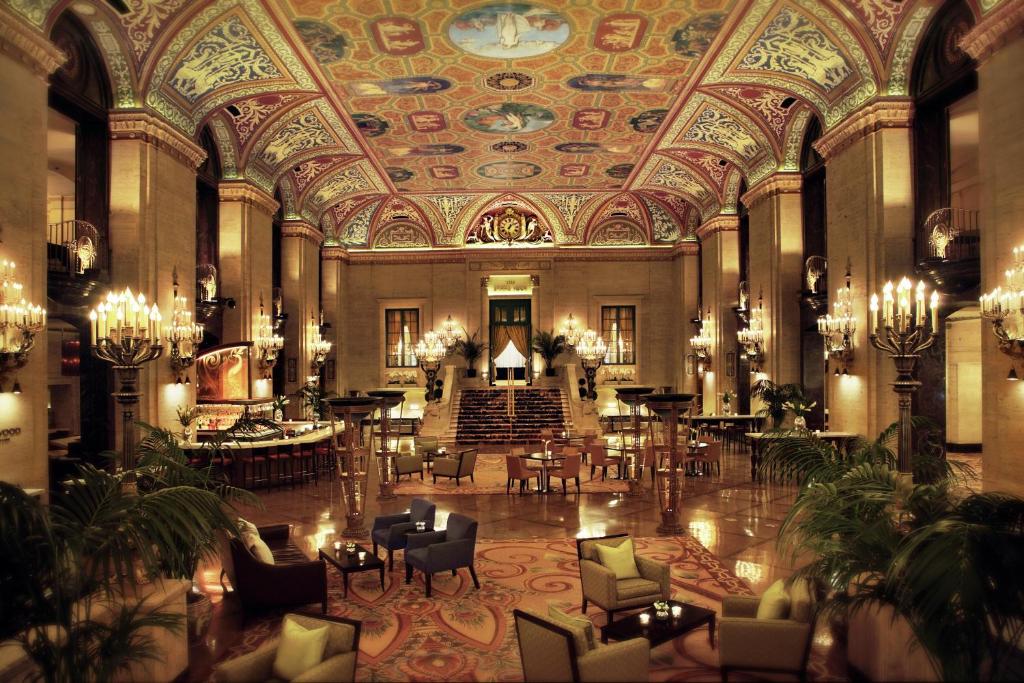
The lobby ceiling that makes you stop mid-stride — 21 Rigal panels, Loop landmark since 1927
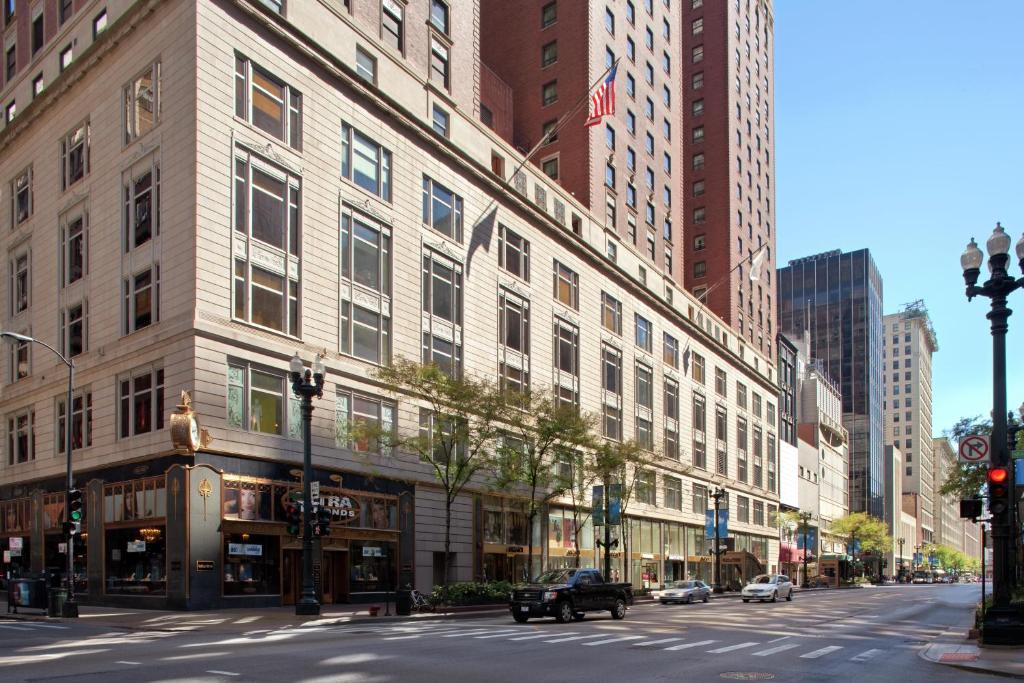
The Monroe Street corner, steps from the Loop