| Location | Savannah Historic District, Georgia, USA |
| Price range | ~$180/€165/£141 — ~$550/€504/£432 per night |
| Best for | History lovers, couples, solo wanderers, anyone who likes Spanish moss and bourbon |
| Sweet spot | March–May or October–November. Summers are brutally humid |
| Skip if | You need a pool, a gym, or a hotel that doesn’t occasionally creak at 3am |
| Book | Browse Savannah historic district hotels on Booking.com |
I arrived in Savannah on a Tuesday afternoon in October and made the mistake of walking to my hotel from the train station instead of taking a cab. This was not a mistake. This was one of the better decisions I’ve made on a trip.
In Savannah, Georgia, the Historic District is the most popular area to stay, with preserved streets and hotels within walking distance of attractions, shops, and restaurants. It’s one of the few places in America where the urban fabric from the early 19th century is still largely intact — the grid of squares, the live oaks, the Federal and Regency townhouses, the cobblestone lanes. Walking through it feels like stepping directly into Savannah’s past. I dropped my bag, put on shoes with better soles, and spent the rest of the afternoon doing nothing but walking and looking.
The hotels here are part of that fabric. Most of them are in buildings that have been something else first — a cotton warehouse, a private mansion, a bank, a boarding house for sailors. What makes them memorable is the mix of stunning architecture, vibrant local history, and southern hospitality. The history isn’t a theme. It’s structural.
Here’s what nobody tells you about staying in Savannah’s historic district: pick your location within the district carefully. The squares are not all equal. A hotel on Forsyth Park is a different experience from one on Bay Street. I’ll tell you exactly which ones are worth it.
Browse Savannah historic hotels on Booking.com
What Savannah’s Historic District Actually Is (The Part Travel Writers Usually Skip)
Savannah was founded in 1733 by James Oglethorpe as a planned city — one of the earliest examples of urban planning in the American colonies. The grid of 24 squares (22 survive) was designed with deliberate military and civic logic: each square was surrounded by civic lots and home lots, creating a city that was simultaneously defensive, democratic, and beautiful.
It also prospered enormously on cotton and enslaved labor. The antebellum wealth that built the mansions, the churches, and the hotels is inseparable from that history. The city has been doing complicated, sometimes insufficient work of acknowledging this. When you walk Savannah’s squares and admire the architecture, you’re walking through the physical record of both things simultaneously.
I say this because the “charming Southern city” framing that dominates most Savannah travel writing papers over something that’s worth understanding before you arrive. The history here is real and it’s layered and the best hotels in the district are the ones that don’t try to reduce it to a ghost tour and a glass of sweet tea.
That said: the city is genuinely beautiful, the food is excellent, the pace of life in the squares on an October morning is one of the most restorative experiences I’ve had in America, and the bourbon flows freely. Both things are true at once.
The Hotels — Which Are Worth It
1. The Mansion on Forsyth Park (Est. 2003, building from 1888)
Hotel Bardo, formerly known as the Mansion on Forsyth Park, occupies a Victorian mansion originally constructed in 1888 that was expanded and converted in the early 2000s into a boutique hotel. It’s not the oldest property in the district but it’s the most maximalist — 700 pieces of art in the common areas, a Victorian aesthetic taken to its logical extreme, a spa that occupies the original carriage house.
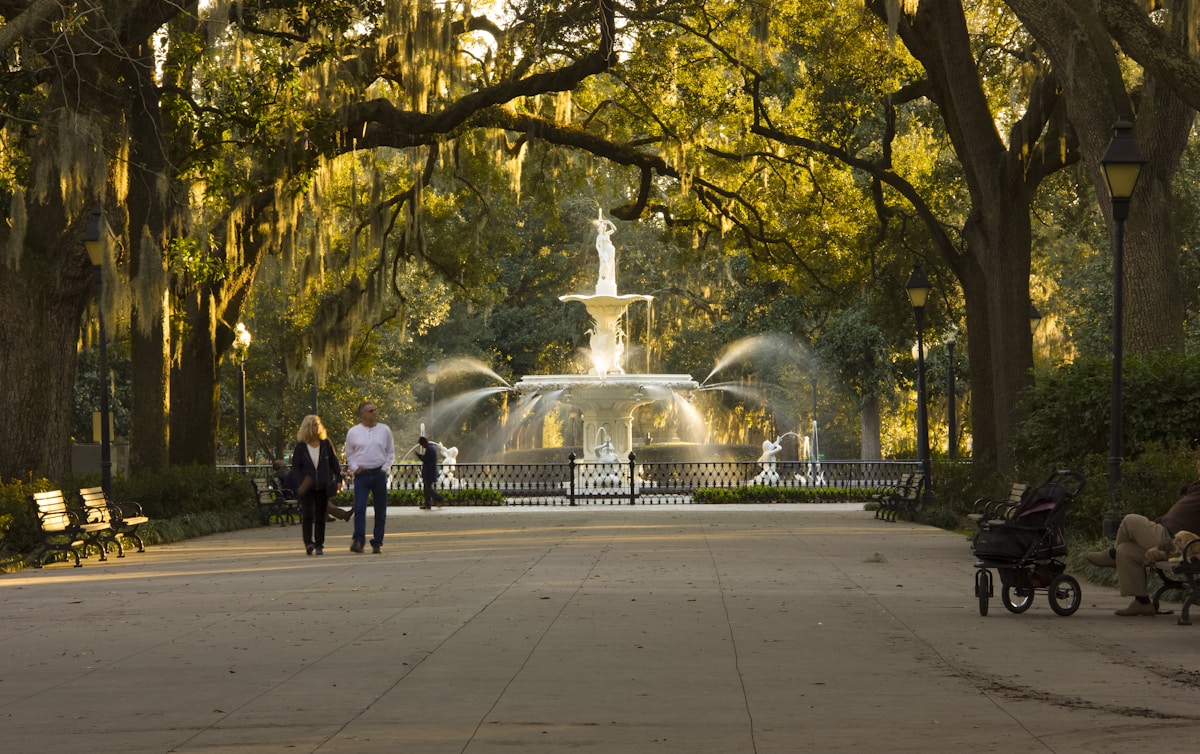
The location on Forsyth Park is the thing. It sits directly across from the park, with nearby dining options that are easy to reach on foot. Forsyth Park is 30 acres of live oaks and Spanish moss, and staying immediately adjacent to it means you have a private city park essentially as your front garden. I ran through it at 7am and had it almost entirely to myself. The fountain at the center, built in 1858 and modeled on a Parisian design, is one of the most photographed things in Savannah — and it’s 90 seconds from your room.
Hot take: this is the best hotel in Savannah for first-time visitors because the location removes all decisions. Forsyth Park is the geographic center of the best part of the historic district. Everything radiates from it.
| Room Type | Size | Price/night | Best for |
|---|---|---|---|
| Deluxe room | 35m² | ~$320/€293/£251 | Solid base |
| Forsyth Park view | 42m² | ~$420/€385/£329 | Worth the upgrade |
| Victorian suite | 65m² | ~$550/€504/£431 | Special occasion |
Check availability at The Mansion on Forsyth Park →
2. The Marshall House (Est. 1851)
The Marshall House is the oldest continuously operating hotel in Georgia, and I mean continuously in the most specific sense — it was built in 1851, has been taking guests since then with only brief interruptions, including two stints as a Union Army hospital during the Civil War, and remains one of the top historic hotels in Savannah.
I wrote about this hotel in the haunted hotels piece, but it deserves a full treatment here because it’s genuinely excellent on its own terms, separate from the macabre history. The building is on Broughton Street — Savannah’s main commercial drag — which puts you within easy walking distance of major attractions in the historic district. The original pine floors are from 1851. The ballroom has been hosting events since before the Civil War.
Here’s the real talk on why I keep recommending it: the Marshall House has figured out how to be a historic hotel without being precious about it. Reviews consistently praise the staff as friendly, helpful, and welcoming. The bar is a proper working bar, not a museum piece. The breakfast is legitimately one of the better breakfasts in the district — biscuits and gravy that I still think about, shrimp and grits that represent the Lowcountry at its best. There are also thoughtful complimentary amenities, like coffee, tea, and water available through the day.
The renovation uncovered human bones beneath the floorboards in 1999 — remnants of the Civil War hospital era. The hotel handled this seriously, reinterred the remains, and moved forward. That kind of institutional honesty is rare and worth noting.
| Room Type | Size | Price/night | Best for |
|---|---|---|---|
| Standard room | 28m² | ~$220/€202/£173 | Best value in district |
| Deluxe room | 36m² | ~$280/€257/£219 | More space, same vibes |
| Junior suite | 50m² | ~$380/€348/£298 | Anniversary or treat |
Check availability at The Marshall House →
3. Kehoe House (Est. 1892)
The Kehoe House is an 1892 Italianate mansion that was built by William Kehoe, an Irish immigrant who made his fortune in iron foundry, as a private home for his wife and ten children. It became a hotel in 1992 and has 13 rooms — which tells you the scale of the original family home.
The iron detailing on the facade is from the Kehoe Iron Works itself, which was a meaningful flex at the time. The twin chimneys are the building’s signature feature and the most photographed element of Columbia Square. Inside, the original plasterwork, the carved mantels, and the proportions of the rooms reflect a specific moment in post-Civil War Georgia prosperity — a man who arrived with nothing demonstrating what he’d built.
I had breakfast on the front porch in October and watched the square for an hour while drinking exceptionally good coffee. A couple walked by with a dog. A woman read a book on one of the square’s benches for the entire time I sat there. The light was the specific low gold of Southern autumn. This is the correct use of a Savannah morning and the Kehoe House facilitates it better than anywhere else I’ve stayed.
| Room Type | Size | Price/night | Best for |
|---|---|---|---|
| Classic room | 30m² | ~$280/€257/£219 | Intimate historic feel |
| Deluxe room | 40m² | ~$380/€348/£298 | More comfort |
| Carriage house suite | 60m² | ~$480/€440/£376 | Privacy and garden access |
Check availability at Kehoe House →
4. The Gastonian (Est. 1868)
Two connected Regency townhouses from 1868, converted into a 17-room inn that consistently tops “best B&B in Savannah” lists and consistently deserves to. The Gastonian is the most residential-feeling property in the district — staying here is the closest you can get to actually living in one of these houses rather than visiting it.
Travelers wanting a more overtly Victorian, luxurious alternative often look at the Hamilton-Turner Inn, an 1873 mansion in Savannah’s historic district known for its grand architecture.
The fireplaces work. The bathtubs are clawfoot and generous. The owner’s cat occasionally appears in the parlor. The breakfast is cooked to order and served on actual china.
Here’s the thing I didn’t expect: the Gastonian is the quietest property in the district. The residential streets around it see almost no tourist foot traffic. You’re five minutes from everything but the noise doesn’t reach you. After two days at properties on busier streets, I understood immediately why the Gastonian’s guests tend to return.
| Room Type | Size | Price/night | Best for |
|---|---|---|---|
| Standard room | 28m² | ~$280/€257/£219 | Residential feel |
| Deluxe with fireplace | 38m² | ~$350/€321/£275 | Winter visits |
| Suite | 55m² | ~$480/€440/£376 | Full townhouse experience |
Check availability at The Gastonian →
Food & Drinks — The Actual Guide
Savannah’s food scene is genuinely one of the best in the American South, and it clusters around the historic district in a way that makes walking from dinner to a bar to a late drink almost inevitable.
- Breakfast: The Marshall House does the best hotel breakfast (~$22/€20/£17 per person). For off-property, The Collins Quarter on Bull Street — Australian-influenced brunch in a Victorian building, ~$18–25/€16–23/£14–19, expect a wait on weekends
- Signature cocktail: Peach bourbon anything, anywhere. Savannah runs on peach bourbon. Budget ~$14–18/€13–16/£11–15 at any historic district bar
- Must-order dish: Shrimp and grits. Not optional. Every restaurant in the district does a version; the best I found was at The Grey on MLK Boulevard (~$28/€26/£22) — a James Beard-nominated kitchen in a 1938 Greyhound bus terminal
- The bar move: Artillery Bar on Bull Street, in a 19th-century building that was actually an armory. The whiskey selection is serious and the staff know their history
Things Most Savannah Hotel Guides Get Wrong
-
The squares are not all equal and your hotel’s square matters. Reynolds Square (home to the Marshall House) is lively and central. Monterey Square is quieter and more residential. Troup Square has a beautiful armillary sphere sundial from 1851. Research your specific square before booking — the neighborhood texture is different in each one.
-
Bay Street hotels have a view and a noise problem. The Bohemian and similar riverfront properties have excellent Savannah River views and road noise that starts early. If you’re a light sleeper, go inland one block.
-
The ghost tour industrial complex is real and ubiquitous. Savannah has more ghost tour companies per capita than any other American city I’m aware of. They crowd the streets from 8–11pm and make certain parts of the historic district feel like a Halloween theme park. Factor this in if you’re visiting in October.
-
The humidity in summer is not a vibe. June through August in Savannah is genuinely difficult. The city was built before air conditioning and the architecture that makes it beautiful also makes it a heat trap. October and April are the months. I am not being dramatic.
-
Park once and walk everything. The historic district is 2.5 square miles. Every hotel on this list is within 15 minutes’ walk of every other major attraction. A car in Savannah is actively counterproductive — parking is expensive, streets are narrow, and walking is the point.
The Catch
-
Peak season prices are steep for what you get. October and March see significant rate increases. The Marshall House in particular can run 40% higher in peak months. Book early or go in November.
-
Small historic hotels mean small bathrooms. The Gastonian and Kehoe House were built as private homes in the 1860s–1890s. The bathrooms were retrofitted. They’re charming. They’re not spacious.
-
Savannah’s tourism infrastructure is strained. The city gets roughly 14 million visitors a year in a district you can walk across in 25 minutes. Popular restaurants require reservations, popular squares fill with tour groups, and certain blocks feel like Disneyland on weekends. Stay Sunday through Thursday if possible.
-
The heat is not metaphorical. I keep mentioning this because I’ve seen people show up in July genuinely unprepared. The city is in a subtropical climate. Plan accordingly.
Is It Worth It?
| Worth it? | |
|---|---|
| History lovers | ✓ One of the best-preserved historic districts in America |
| Couples | ✓ The squares, the light, the pace — it’s built for this |
| Food travelers | ✓ Genuinely excellent food scene |
| Summer visitors | ⚠️ Possible but uncomfortable — peak heat and humidity |
| Budget travelers | ⚠️ Marshall House is the best value; everything else is a stretch |
| Beach seekers | ✗ Wrong trip. Tybee Island is 20 minutes away but that’s a different vibe entirely |
Savannah rewards visitors who slow down and pay attention. The historic district is not a series of attractions — it’s a place to inhabit for a few days. The appeal of staying in these hotels is the combination of location, antebellum or Victorian architecture, and Southern hospitality, which is really the core of the Savannah experience. Stay in one of these hotels, walk the squares at 7am before the tours start, eat at The Grey, sit on a bench in Forsyth Park with a coffee and do nothing for an hour. That’s the trip.
Practical Info
- Address area: Historic District is bounded by the Savannah River to the north, Gwinnett Street to the south, roughly E. Broad to Price Street east-west
- Getting there: Savannah/Hilton Head International Airport (SAV) → 20 minutes, ~$30/€27/£23 by rideshare
- Getting around: Walk everywhere in the historic district. Rideshare for trips to the river or outlying areas
- Check-in: Most properties: 3pm / Check-out: 11am
- Parking: ~$25–35/€23–32/£19–27 per day at historic district garages. Not worth it — park once and leave the car
- WiFi: All properties have it; speeds vary in older buildings
- Pet friendly: Kehoe House and The Gastonian allow small dogs with prior notice
Final Verdict
The historic hotels in Savannah’s historic district are some of the best-value historic accommodations in America. You’re getting buildings with genuine 19th-century bones, locations inside one of the country’s most intact historic urban environments, and hospitality that reflects a Southern tradition of taking guests seriously.
My ranking: Marshall House for first-timers (location, value, history), Kehoe House for couples (intimacy, architecture, the square), The Gastonian for those who want to actually live in the neighborhood rather than visit it.
Book before you think you need to. October especially.
Browse Savannah historic district hotels on Booking.com
Prices start at ~$180/€165/£141 per night at The Marshall House. Peak season (October, March–April) rates run 30–40% higher.
Affiliate Disclosure: Some links in this article are affiliate links. We may earn a small commission if you book through them, at no extra cost to you.

Written by
Thomas Waverly
Travel Correspondent
Thomas covers East Coast, Southern, and Western grand hotels. He has personally stayed in over 80 historic properties and considers a properly aged lobby bar essential to any review.