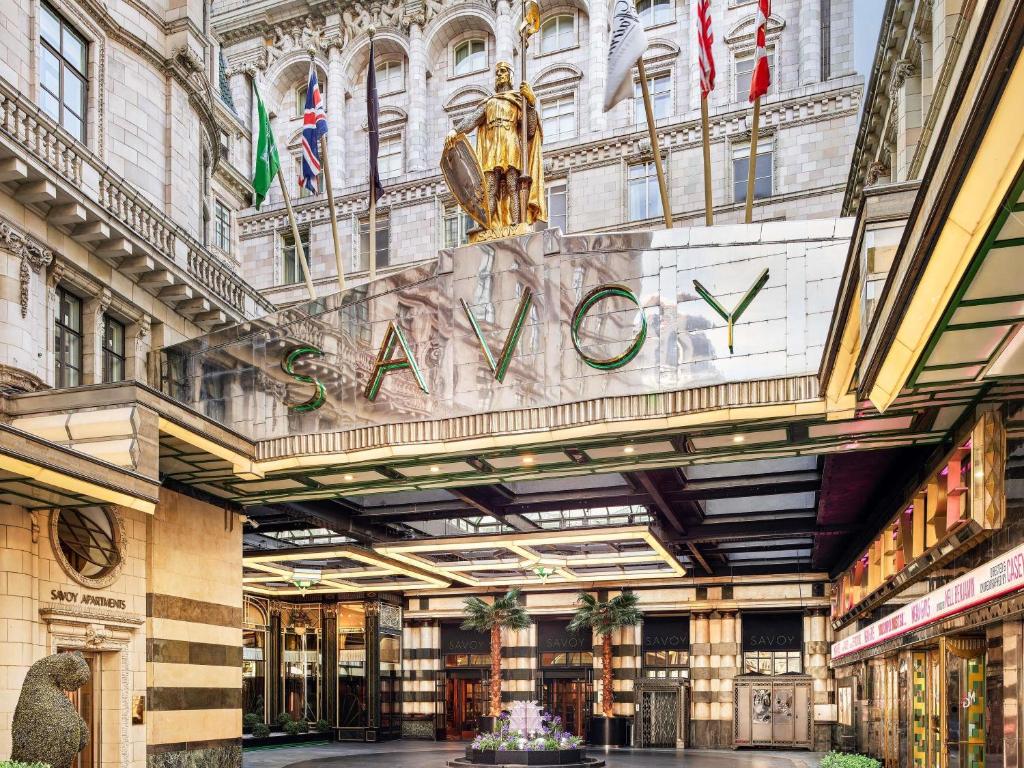
London, England
The Savoy
Est. 1889 · Victorian / Edwardian Grand Hotel · $$$$
Opened in 1889 as Britain's first hotel with electric light throughout, the Savoy gave the world César Ritz, Auguste Escoffier, and Monet's foggy Thames — and after a £220 million restoration, it's still the Strand's most theatrical address.
I checked in on a Tuesday afternoon and within four minutes a doorman in a top hat had told me, unprompted, that the revolving door I’d just walked through was not the original — the original was destroyed in the Blitz, rebuilt after, and yes, people ask about it constantly, and yes, he doesn’t mind. That’s the Savoy in one interaction: everything has a story, everyone on staff knows it cold, and they will tell it to you with the practiced warmth of people who have been doing this since 1889 and intend to keep doing it.
By the time I’d had one cocktail at the American Bar — poured by a man who could tell you the provenance of every bottle behind him without looking — I understood why this hotel doesn’t just sit on the Strand, it anchors it. Everything on that stretch of river, the theatre next door, the taxis idling outside, seems to orbit the building rather than the other way around.
I’ve stayed in a lot of hotels that call themselves historic. Most of them mean the building is old. The Savoy means something closer to: this is where several things that define modern hospitality were invented, on purpose, by people who worked here.
Quick Facts
| Location | Strand, London WC2, on the River Thames |
| Price range | $$$$ (from ~$800/night for standard rooms) |
| Best for | Luxury travelers, history lovers, theatre-goers, afternoon tea, special occasions |
| Sweet spot season | Late spring or early autumn — good light on the river, theatre season in full swing, fewer American tour groups than July/August |
| Skip if | You want a quiet base for casual sightseeing on a mid-range budget, or you find formality exhausting |
| Book it | Book on Booking.com |
The History Nobody Tells You
The Savoy opened on August 6, 1889, and it was, by any measure available at the time, a building from the future. It was the first hotel in Britain with electric lighting throughout — no gas lamps flickering in the corridors, no candle stubs by the bed — and the first with electric lifts, which guests at the time called “ascending rooms” because the word “elevator” hadn’t fully caught on and the concept of a room that moved was still, genuinely, a little unsettling. Most of its rooms had private bathrooms attached, which in 1889 was less an amenity than a declared philosophy: guests should not have to walk down a hallway to bathe like it’s 1850. Richard D’Oyly Carte built the whole thing with money made producing Gilbert and Sullivan comic operas at the Savoy Theatre next door — a theatre he’d built eight years earlier that was, itself, the first public building in the world lit entirely by electricity. He clearly liked being first at things.
He was also smart enough to hire the right people to run it. César Ritz became the Savoy’s first general manager and Auguste Escoffier its first head chef, and between them they more or less invented the modern idea of what a grand hotel restaurant should feel like — the service choreography, the menu structure, the idea that dining in a hotel could be an event rather than a convenience. Both men eventually left to start hotels under Ritz’s own name, but they built their reputations here first, on the Strand, figuring out how service should work by doing it in front of paying guests every night.
A decade later, Claude Monet checked into a room with a balcony over the river and more or less stayed there, on and off, painting the same view of Waterloo Bridge and Charing Cross Bridge dozens of times between 1899 and 1901, chasing the exact quality of London fog at the exact hour it turned the water the color he wanted. The paintings are in museums now. The balcony is still there. If you get a river-facing room on the right floor, you’re looking at roughly the same angle he was, minus the coal smoke.
Winston Churchill used the Savoy for War Cabinet lunches during the Second World War — a working lunch with the stakes of a war, in a dining room built for theatre people and industrialists. It says something about the hotel that it could hold both registers, decades apart, without the building itself seeming to notice the difference. If you want to see the room where a fair amount of that history actually happened rather than just read about it, book a stay and walk it yourself — a lot of it is still recognizably the same layout.
The Rooms — Real Talk
Standard rooms run somewhere around $800–$1,000 a night depending on the week, which is a genuinely painful number to type but is, for central London in a Grade II listed building with this history, roughly in line with what the market bears. They’re smaller than you might expect for the price — this is a Victorian building, not a modern tower, and the bones don’t stretch — but they’re finished with real care: heavy fabrics, deep tubs, the kind of writing desk that makes you feel like you should be composing something more important than a postcard.
River-facing and deluxe rooms move up to $1,200–$1,800, and this is where I’d actually spend the extra money if the budget allows it. The Thames view is the entire point of staying at the Savoy over a dozen other London luxury hotels — it’s the view Monet obsessed over, and at dusk with the lights coming on along the Embankment, you understand exactly why.
The Suites
Suites start around $2,500 and climb sharply from there, with named suites tied to specific former guests running well beyond that. They’re genuinely spectacular — separate sitting rooms, butler service on request, the works — but they’re also priced for people who are not asking how much they cost, so book knowing that’s the tier you’re entering.
| Room Type | USD | EUR | GBP |
|---|---|---|---|
| Standard room | $800–$1,000 | €740–€920 | £630–£790 |
| Deluxe / river-view room | $1,200–$1,800 | €1,100–€1,660 | £950–£1,420 |
| Junior suite | $2,000–$2,500 | €1,840–€2,300 | £1,580–£1,980 |
| Signature suite | $2,500+ | €2,300+ | £1,980+ |
Prices are approximate and swing with season, event calendar, and how far out you book. A random weeknight check came in around $940 for a standard room — treat that as a realistic midpoint, not a floor.
Food & Drinks
The American Bar is the reason a lot of people book the Savoy in the first place, and it deserves the reputation. It’s one of the oldest continuously operating cocktail bars in the world, and it’s credited with a fair amount of the job of popularizing cocktail culture in Britain in the first place — the hotel’s own Savoy Cocktail Book, first published in 1930, is still treated as scripture by bartenders who’ve never set foot in London. Order something off the classics list rather than trying to be clever; the bartenders have been perfecting these for close to a century and it shows.
Afternoon tea happens in the Thames Foyer, under a glass dome, with a pianist playing softly enough that you can actually hold a conversation over the scones. It is, unapologetically, a tourist ritual as much as a local one — book weeks ahead, because it sells out constantly and the hotel does not seem inclined to add more seatings just to accommodate demand.
Savoy Grill is the more serious dining option — proper British and French classics, done exactingly, in a room with genuine old-hotel weight to it. It’s not cheap and it’s not casual, but it’s the meal to have if you want the full ceremony rather than a quick dinner before the theatre next door.
Things I Noticed That Most Reviews Miss
The theatre connection is still load-bearing, not just historical trivia. The Savoy Theatre is genuinely attached to the hotel’s identity — it’s the reason the whole property exists — and staff will point you toward whatever’s playing next door with real enthusiasm, not a scripted concierge line.
The American Bar gets meaningfully quieter after 10pm on weeknights. Everyone piles in right after work and after theatre curtain calls; if you want to actually talk to the bartenders about what they’re pouring, go later.
Not every room has the river view, and the difference in experience is bigger than the room rate suggests. A Strand-facing room and a Thames-facing room in the same category feel like different hotels. If the view matters to you at all, pay for it.
The staff’s grasp of the hotel’s own history is unusually deep and unscripted. I asked a doorman a throwaway question about the electric lifts and got a genuinely detailed, unprompted answer about the 1889 opening that felt like actual knowledge rather than a memorized fact sheet.
The restoration is invisible in the best way. The three-year, roughly £220 million rebuild that closed the hotel from 2007 to 2010 doesn’t read as a renovation at all — nothing feels overly polished or disconnected from the building’s age, which is a much harder trick to pull off than building something new.
The Catch
The price is the price — this is a $$$$ hotel in the fullest sense, and there’s no version of a Savoy stay that reads as a bargain. If you’re budget-conscious even within the luxury category, this isn’t the place to test that boundary.
Non-river-facing rooms catch real Strand traffic noise, and the Strand is a genuinely busy road. Ask specifically about room location when booking if you’re a light sleeper — “central London” and “quiet” are not always compatible here.
The formality can feel like a lot if you’re not in the mood for it. This is a hotel that performs Grand Hotel, deliberately and consistently, and if you want to shuffle down to breakfast in gym clothes and be left alone, that’s not really the register the building operates in.
The lobby and Thames Foyer fill with non-guests booked in purely for afternoon tea, which means at peak tea hours the public spaces can feel more like a tourist attraction than a hotel lobby. If you’re sensitive to crowds in your hotel’s common areas, plan around the 2–5pm tea window.
Is It Worth It?
| Traveler Type | Verdict |
|---|---|
| First-time London luxury splurge | Yes — few hotels deliver this much specific history for the price |
| Budget or mid-range traveler | No — go elsewhere and spend the savings on theatre tickets |
| Theatre-goers | Yes — the Savoy Theatre is next door, this is the obvious pairing |
| Business traveler wanting quiet, efficient stays | Maybe — book a river-facing room away from the Strand side |
| Anniversary / proposal trip | Yes — it’s built for exactly this kind of occasion |
Practical Info
- Address: Strand, London WC2R 0EU, England
- Check-in / check-out: 3:00 PM / 12:00 PM
- Parking: Valet parking available on-site; expensive, as with anywhere in central London — public transport is genuinely easier
- WiFi: Complimentary throughout
- Nearest airport: London Heathrow (LHR), roughly 45–60 minutes by car depending on traffic; Charing Cross and Covent Garden underground stations are both a short walk away
- Languages: English primarily, with multilingual staff on hand for major European and Asian languages
Final Verdict
The Savoy isn’t trying to be the newest or the most fashionable hotel in London, and it doesn’t need to be — it was doing the “first of its kind” thing back in 1889, and everything since has been about maintaining that standard rather than chasing a new one. If you want a hotel that comes with genuine, load-bearing history — Ritz and Escoffier, Monet on the balcony, Churchill’s War Cabinet, a cocktail bar that helped invent the category — and you’re prepared to pay what that history costs, book the Savoy and don’t think too hard about the exchange rate.
Standard rooms run roughly $800–$1,000 a night, river-view and deluxe rooms $1,200–$1,800, and suites from $2,500 up. Book river-facing rooms and Thames Foyer afternoon tea well in advance — both sell out faster than the sticker price would suggest.
This page contains affiliate links. If you book through them, Historic Hotel Guide may earn a small commission at no extra cost to you.

Curated by
Eleanor Rhodes
Founding Editor
Eleanor has spent 20 years documenting America's endangered historic properties. A certified historic preservation specialist, she believes the best way to save old hotels is to fill their rooms.
Affiliate Disclosure: Some links on this page are affiliate links. We may earn a small commission when you book through them, at no extra cost to you. This supports our editorial work.
Highlights
The Savoy's famous forecourt entrance on the Strand
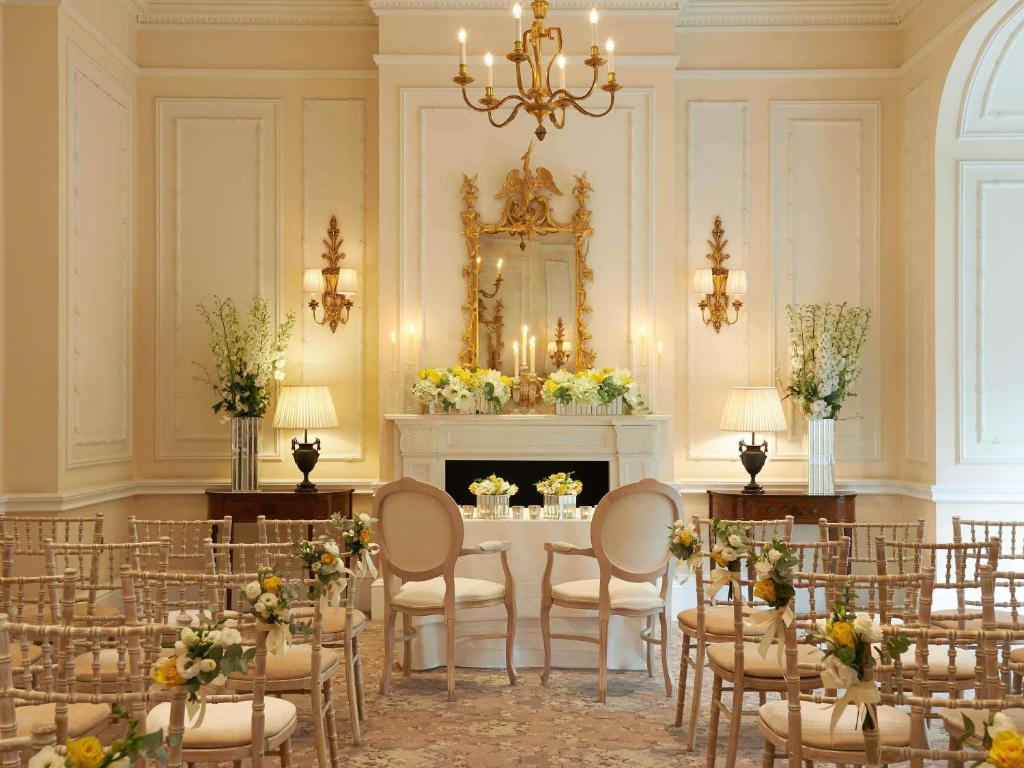
One of the hotel's function rooms, dressed for an occasion