| Coverage | Scotland, Austria, France, Ireland |
| Price range | ~$270/night (Château d’Artigny) — ~$1,160/night (Inverlochy Castle) |
| Best for | People who want turrets, tartan, and a wine list, in that order |
| Sweet spot | Late May through early September — everything else is drizzle and a 4pm sunset |
| Skip if | You need to be within an hour of an international airport, or your budget caps at $300 across the board |
| Book | Browse castle hotels on Booking.com |
I want to get one thing out of the way before we start, because it will save you money and disappointment: almost none of these are castles. Not in the “besieged, defended, occupied by a garrison for four centuries” sense. They’re baronial mansions, hunting lodges, and — in one case — a perfume magnate’s fantasy of what a château should look like, built in 1912 with indoor plumbing already installed. That’s not a knock. Some of the best hotel experiences in Europe are architectural cosplay done extremely well. But I’ve had readers write in furious that their “castle” had central heating and a spa menu, so let’s set expectations correctly from the first paragraph.
I booked five of the most-recommended castle hotels in Europe over the course of a year — three in the UK and Ireland, one in Austria, one in France — specifically to figure out which ones earn the word “castle” and which ones are borrowing it. I also, for context, spent one night at the actual medieval Ashford Castle (1228, siege history, the works) so I’d have a real baseline to compare everything else against. Spoiler: that comparison is not kind to most of the industry.
Here’s the honest version of what you’re paying for at each of these five: history that ranges from “genuinely 570 years old” to “built the year the Titanic sank,” settings that are uniformly spectacular, and a price tag that has very little to do with either.
What “Castle Hotel” Actually Means
There are three real categories hiding under one marketing word, and knowing which one you’re booking changes what you should expect.
Genuine medieval or early-modern fortifications. Ashford Castle itself — not The Lodge, the actual castle on the same estate — dates to 1228 and was expanded by the Guinness family into its current fairy-tale form after they bought the estate in 1852. That’s the real thing: defensive walls, centuries of ownership changes, actual siege history. It’s also its own, separate, considerably more expensive hotel, and not what most people are booking when they search “castle hotel Europe.”
Victorian and Edwardian baronial revival. This is the bulk of what’s actually bookable. Inverlochy Castle (1863) and Fonab Castle (1892) are both this: 19th-century Scottish gentry building turreted, crenellated country houses because Queen Victoria had made the Highlands fashionable and everyone with new industrial money wanted a piece of the aesthetic. They’re beautiful. They’re also younger than the Eiffel Tower.
Early 20th-century château revival. Château d’Artigny is the extreme version — built between 1912 and 1929 for the perfume magnate François Coty, deliberately designed to look like it belonged among the genuine Loire châteaux nearby, even though it postdates the Wright Brothers’ first flight. It’s gorgeous and it is, structurally, a very well-funded stage set.
And then there’s Schloss Fuschl, which is the one property on this list that predates the baronial revival trend entirely, going back to a 1450s hunting lodge for the Prince-Archbishops of Salzburg. More on that below.
The Castles — Real Talk on Each One
1. Inverlochy Castle Hotel — Torlundy, near Fort William, Scotland (Built 1863)
Let’s start with the biggest offender of the “castle” branding, because it’s also, unfortunately, the best hotel on this list. Inverlochy was never a fortress. Lord Abinger built it in 1863 as a private baronial residence at the base of Ben Nevis, the highest mountain in the UK, on the shore of a private loch. No siege ever happened here. The closest it comes to drama is Queen Victoria visiting in 1873 and writing in her journal that she “never saw a lovelier or more romantic spot” — which, fair, because the setting genuinely is that good.
I arrived at dusk in September, and the drive up from Fort William does the thing every Highland castle brochure promises and almost none deliver: the mountain, the water, the turrets, all lined up like it was staged. It wasn’t staged. That’s just where the house sits. Dinner was serious — proper Scottish country house cooking, a wine list that clearly has a full-time sommelier behind it — and the staff have the specific, unhurried confidence of people who’ve worked somewhere genuinely excellent for a long time.
It is not, however, remotely a bargain. Rooms here run into four figures a night, and you’re paying for the mountain and the loch and Queen Victoria’s endorsement as much as for the building itself.
Rooms: ~$1,150–1,160/night, and that’s before you look at the suites.
Check availability at Inverlochy Castle →
2. Fonab Castle Hotel — Pitlochry, Scotland (Built 1892)
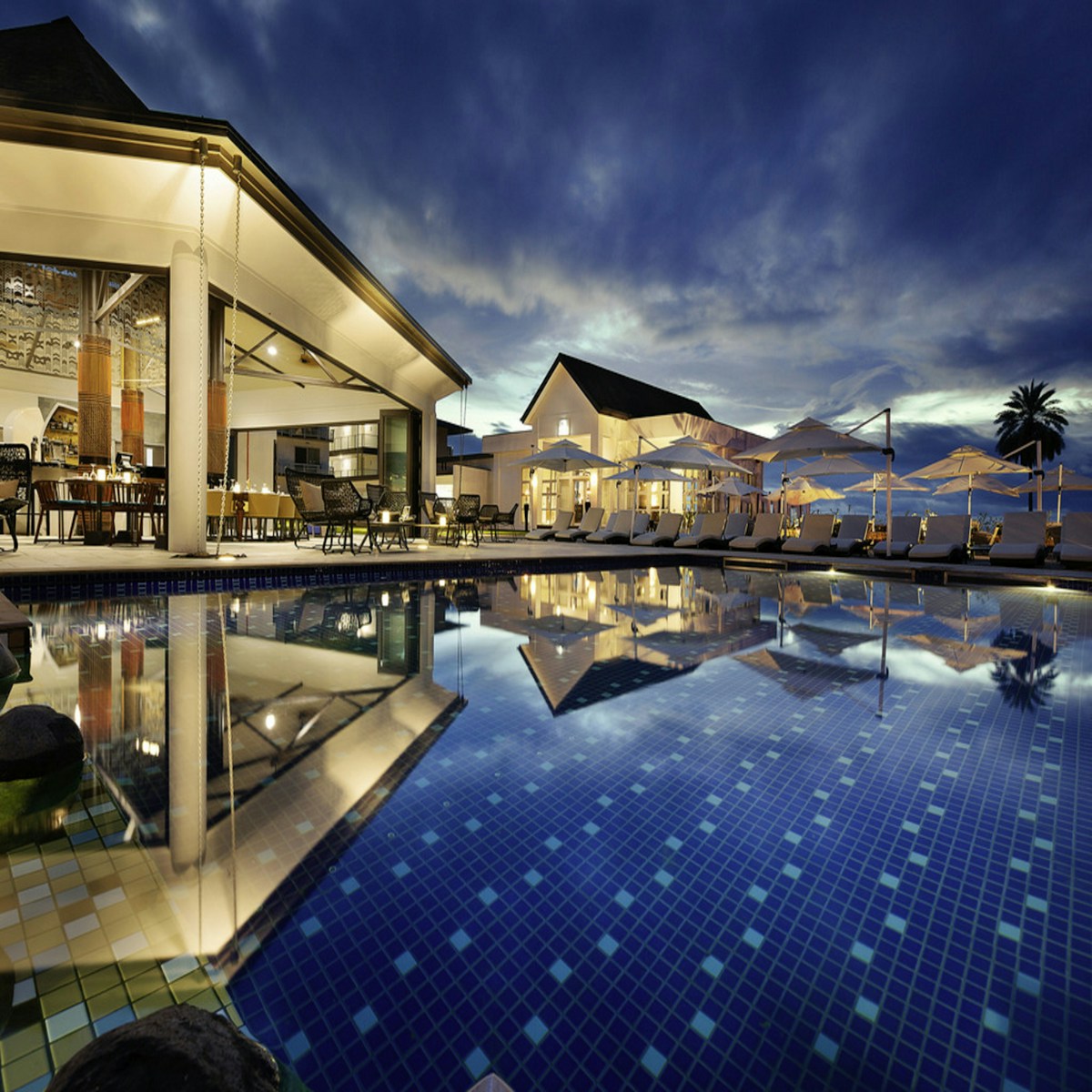
Fonab is the relative bargain on this list, and I mean that entirely in castle-hotel terms — $420 a night is still real money, it just looks modest next to Inverlochy. Built in 1892 as a baronial mansion for a wealthy jute merchant, Fonab has genuine 19th-century Scottish architecture but a thoroughly modern hotel bolted onto it: a spa wing and an infinity pool that looks straight out over Loch Faskally, which is the single best pool view I’ve encountered at any hotel on this list, castle or otherwise.
The split personality is obvious the moment you walk in. The original house has the wood paneling and turret rooms you want from a baronial pile. The new build has floor-to-ceiling glass and a treatment menu that would be at home at a big-city spa hotel. I found this more charming than jarring — it’s an honest hybrid rather than a building pretending to be something it isn’t throughout.
Pitlochry itself is a proper Highland town with distilleries nearby, which makes Fonab a good base if you want castle atmosphere without committing your entire trip budget to one hotel bill.
Rooms: ~$420–430/night — the relative budget option on this list, which tells you something about castle-hotel pricing generally.
Check availability at Fonab Castle →
3. Rosewood Schloss Fuschl — Hof bei Salzburg, Austria (Built 1450s)
This is the one that actually earns the historical weight the word “castle” implies. Schloss Fuschl started life in the 1450s as a hunting lodge for the Prince-Archbishops of Salzburg — genuinely medieval, genuinely built for the aristocracy rather than for tourists. It later passed to the German industrialist Gustav Kustermann, and was requisitioned during the Second World War, which is a much heavier chapter of European history than anything happening at the baronial revival properties on this list.
It sits directly on Lake Fuschl, a short drive from Salzburg, in the same lake district where scenes and locations for The Sound of Music were filmed in 1965 — you can see why; the light on the water in the early evening looks almost deliberately cinematic. Rosewood took over operations and did what Rosewood does: the service is exact, the spa is excellent, and the restaurant takes the lake and mountain setting seriously rather than treating it as wallpaper.
What struck me most was the sense of accumulated time. Inverlochy and Fonab feel like well-preserved 19th-century houses. Schloss Fuschl feels like a building that has watched several centuries of European history happen around it, then quietly modernized.
Rooms: ~$1,010–1,020/night.
Check availability at Rosewood Schloss Fuschl →
4. Château d’Artigny — Montbazon, Loire Valley, France (Built 1912–1929)
Here’s the one I’d send a skeptical friend to first, because it makes the honesty argument for this entire article better than I can. Château d’Artigny looks, from the driveway, exactly like the genuine 16th-century Loire châteaux a few miles down the road. It is not one. It was built between 1912 and 1929 for François Coty, the perfume magnate who made Coty a household name, and it’s an 18th-century château revival — meaning it was designed from scratch to evoke a style that was already two centuries old when construction started, on a hill overlooking the Indre river, a tributary of the Loire.
Once you know this, you start noticing it everywhere: the proportions are a little too generous, the symmetry a little too perfect, in the way that only unlimited early-20th-century perfume money can buy. It doesn’t make the place less enjoyable. If anything it’s more fun once you stop pretending it’s ancient and start appreciating it as an extremely committed piece of theater — chandeliers, a rotunda dining room, gardens that look like they were lifted from a Fragonard painting, because that was more or less the assignment.
It is also, by a wide margin, the best value on this list. For roughly a quarter of what Inverlochy or Schloss Fuschl charge, you get grounds, architecture, and a restaurant that would comfortably justify twice the price.
Rooms: ~$270–280/night — genuinely the best value on this list, castle authenticity notwithstanding.
Check availability at Château d’Artigny →
5. The Lodge at Ashford Castle — Cong, County Mayo, Ireland
I need to be precise here because the marketing around this one invites confusion: what you’re booking is The Lodge, a more relaxed lakeside sister property on the Ashford Castle estate — not the medieval Ashford Castle itself, which dates to 1228, was expanded into its current fairy-tale form by the Guinness family during their 1852–1939 ownership of the estate, and is a separate, considerably more expensive hotel on the same 350-acre grounds. The Lodge sits on the shore of Lough Corrib, a few minutes’ drive from the castle, and it is fantastic on its own terms — just don’t book it expecting turrets and a great hall.
I stayed at The Lodge and walked over to the castle for dinner one night, which I’d genuinely recommend as the smart way to experience the estate without paying castle-level room rates. The village of Cong itself has its own claim to fame — it was the filming location for John Ford’s The Quiet Man in 1951, starring John Wayne and Maureen O’Hara, and the town still leans into it, tastefully, with a small museum and a pub that has clearly told the same story to a thousand tourists and still means it.
The Lodge itself is calm, lake-facing, and considerably less formal than the castle up the road, with the same estate access — falconry, boating, the grounds — at a fraction of the price.
Rooms: ~$555–565/night.
Check availability at The Lodge at Ashford Castle →
Things Castle Hotel Marketing Never Tells You
-
Most of them aren’t medieval, and the ones that aren’t will rarely volunteer that fact. Inverlochy, Fonab, and Château d’Artigny are all 19th- or early-20th-century buildings styled to look older. That’s not dishonest exactly, but it’s worth knowing before you’re expecting a great hall with a fireplace big enough to roast an ox.
-
Old wings mean real plumbing and wifi quirks. Even the well-run properties on this list have rooms where the water pressure is a genuine gamble and the wifi drops out somewhere between the second floor and the turret rooms. Ask which building your room is in before you book if connectivity matters.
-
You will need a car, full stop. None of these five properties is walkable from a train station or airport. Inverlochy and Fonab are both a substantial drive from Glasgow or Edinburgh. Schloss Fuschl is 20-plus minutes from Salzburg. The Lodge is well outside Galway. Budget for a rental car and, in Ireland and Scotland, for driving on the left if that’s not your normal.
-
The remoteness is the actual product, not a side effect. People book these places for the isolation and then complain about the isolation. The mountain, the loch, the lake — that’s what you’re paying for, and it comes bundled with a 30–90 minute drive to the nearest airport.
-
Price does not track age. Schloss Fuschl, genuinely 570-plus years old, and Inverlochy, 163 years old, cost roughly the same per night. Château d’Artigny, at just over a century old, costs a quarter of either. History is not the pricing variable here — brand, spa amenities, and lake or loch frontage are.
The Bars — Because You’ll Need One
-
Inverlochy’s drawing room bar: A serious whisky selection in a room with the kind of proportions that make you speak more quietly than usual. Ask for something from the Speyside list and settle in by the fire.
-
Fonab’s pool bar and terrace: Less formal, better for a glass of something cold while looking at the infinity pool and Loch Faskally beyond it. Not the place for a contemplative single malt, but exactly the place for a gin and tonic at 6pm.
-
Château d’Artigny’s rotunda bar: The wine list draws heavily and sensibly from the Loire itself — Vouvray, Chinon, Bourgueil — which is the correct way to drink at a hotel fifteen minutes from the vineyards that make them.
The Catch
-
These are genuinely remote. Every property on this list is 30 minutes to well over an hour from the nearest international airport. That’s part of the appeal and also a real logistical cost — factor in transfer time and a rental car into your total trip budget.
-
The price range is enormous and not always predictable. You can spend $270 or $1,160 a night depending entirely on which property you pick, with no clean correlation to quality, service, or actual historic value.
-
Old-building quirks are real, not charming exaggeration. Drafts in the hallways, creaky floors above the quieter rooms, and heating systems that were clearly retrofitted into 19th-century (or 15th-century) architecture. Bring a layer for the evenings even in summer.
-
You need a car, and often a confident one. Highland roads, Loire back roads, and the lanes around Lough Corrib are not always wide, well-lit, or well-signed. If you’re not comfortable driving unfamiliar roads at dusk, plan transfers in advance.
Is It Worth It?
| Worth it? | |
|---|---|
| Honeymooners with a real budget | ✓ Inverlochy or Schloss Fuschl — go big, it’s a genuine occasion |
| Value-conscious history lovers | ✓ Château d’Artigny, easily — the best history-per-dollar on this list |
| Whisky and Highlands purists | ✓ Inverlochy or Fonab, depending on budget |
| Travelers without a rental car | ✗ Skip all five — none of these are reachable without driving |
| Budget travelers under $300/night | ⚠️ Only Château d’Artigny fits, and even that’s a splurge for some |
| Families wanting castle drama for kids | ⚠️ The Lodge at Ashford, paired with a dinner visit to the actual castle |
The honest answer: these are worth it if you go in knowing what you’re actually buying — setting and service in four cases, genuine centuries-old history in one. None of them are a scam. But “castle hotel” as a category is doing a lot of marketing work that the buildings themselves don’t always back up.
Practical Info
- Nearest airports: Glasgow or Inverness for Inverlochy and Fonab (both roughly 1.5–2 hours by car); Salzburg Airport for Schloss Fuschl (about 25 minutes); Tours-Val de Loire or Paris for Château d’Artigny (Tours is roughly 20 minutes, Paris is about 2.5 hours by car or train plus transfer); Ireland West Airport Knock or Galway for The Lodge at Ashford Castle (both about 45–60 minutes)
- Driving: Assume you need a car for all five properties — none has meaningful public transit access
- Best months: Late May through early September for reliable weather and long daylight in Scotland and Ireland; June through September for Austria and the Loire, which get genuinely hot in July and August
- What to pack: Layers regardless of season — old stone buildings run cold in the evenings even in summer — plus comfortable shoes for estate grounds that are often gravel, grass, or uneven flagstone
- Booking lead time: Inverlochy and Schloss Fuschl book out months ahead for summer weekends; Château d’Artigny is easier to get on shorter notice
Final Verdict
If you want the closest thing to a real historic fortress, book the actual Ashford Castle, not The Lodge — but understand you’re paying for genuine 1228-vintage history and be ready for the bill that comes with it. Of the five hotels I actually reviewed here, Schloss Fuschl is the one with a legitimate claim to serious age, Château d’Artigny is the one that will make your money go furthest, and Inverlochy is the one I’d pick if a client account was footing the bill and I wanted the mountain, the loch, and Queen Victoria’s approval all in one booking.
What ties all five together isn’t authenticity — it’s setting. Every one of these hotels sits somewhere spectacular, and every one of them uses the word “castle” to sell you on that setting more than on the building’s actual age. Go in knowing which century you’re really booking, and you’ll enjoy all five a great deal more than the marketing copy alone would suggest.
Browse castle hotels on Booking.com
Affiliate Disclosure: Some links in this article are affiliate links. We may earn a small commission if you book through them, at no extra cost to you.

Written by
Eleanor Rhodes
Founding Editor
Eleanor has spent 20 years documenting America's endangered historic properties. A certified historic preservation specialist, she believes the best way to save old hotels is to fill their rooms.